
Correlation of Brain, Urban, and Vegetal Networks
Connectomics, as an emerging discipline within neuroscience, applied to architecture and urban planning, can develop into a new, cutting-edge discipline that goes beyond the study of connections to understand the multimodality of patterns and correlations, considering synaptic plasticity, collective vegetal intelligence, and the multifaceted urban perspective.
The main argument of this proposal originates in my doctoral thesis, developed over four years, and based on the analysis of three substantive strands: beginning with the human connectome, and extending toward the urban and vegetal connectomes. Emphasis is placed on the structural considerations of network systems and their correlations. Beyond analogical descriptions related to matrices of brain, vegetal, and urban connections, this work proposes the possibility of articulating a new discipline: the connectomics of cities.
This approach is grounded in ecological coexistence, stemming from our own human, vegetal, and built nature. If connectomics is understood as the study of the connectome through image analysis and network theory—yet extending beyond mere spatial visualization—then the connectomics of cities seeks to move beyond purely structural urban and architectural connections.
Similarly, just as connectomics analyzes the synaptic networks of a healthy brain, and pathoconnectomics studies anomalies in the connectome, an urban pathoconnectomics could serve to identify degraded or harmful connections within the urban network. This perspective proposes an analysis of everyday life to understand urban and architectural synapses across multiple levels, considering the connective correlations among their components. From the foundations of human neurobiology, key principles have been derived to conceptualize the importance of connections and the formation of complex networked systems.
Within the conceptualization of the connectome, the brain is understood as a complex network, organized through patterns and multiple scales, linked to neuronal dynamics in both structure and function. This multiscale, multimodal, structural, and functional demonstration of networks can be compared to urban systems—gray, green, and blue—making it possible to conceptualize an urban green connectome. In this framework, structural components such as nodes and links parallel community systems, pathways, and corridors. The greater the number of connections, the richer the system becomes—in this case, the natural–urban–human ecosystem.
Understanding the brain as a complex network organized across multiple scales that shape neuronal dynamics, network science provides a theoretical framework for its study. The connectome is a comprehensive description of brain connectivity: a fundamental dataset that informs the global design of computational models of the human brain (Sporns, Tononi & Kötter, 2005).
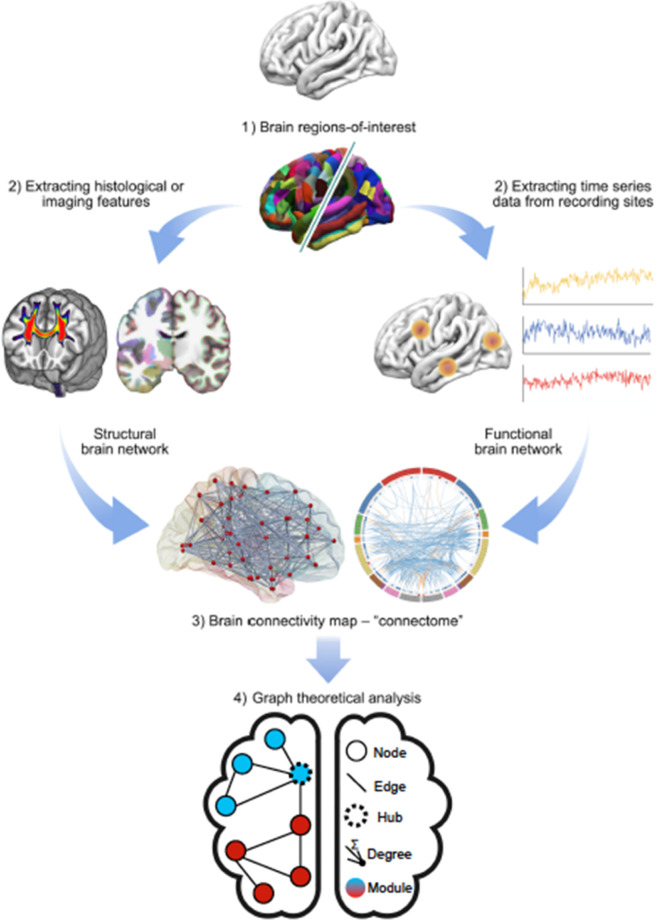
Analysis of brain networks. Structural and functional connectivity. Source: adapted from Prefrontal connectomics: from anatomy to human imaging by Haber, Liu, Seidlitz, and Bullmore (2021).
Mehaffy (2019a) proposes an urban connectome as a basis for developing improved urban policy practices. This builds on the understanding that human beings possess complex patterns of neuronal connections, which transform as we experience and learn. What becomes significant is the overall pattern, and the ways in which different regions of the brain connect and disconnect, forming new connectivity patterns.
The more connection patterns a person's brain can form, the better they can remember and learn. For cities, being well-connected and accessible is essential to facilitate cross-connections. In the case of the brain, the pattern of neuronal cross-connections is key to the formation of consciousness. The system self-organizes when different parts of the brain come together and form an even larger system (Mehaffy, 2019b).
Steven Johnson (2001), in his book Emergent Systems, mentions that much of what happens in cities, as in brains, is related to a general pattern of connections and to a lesser extent to particular elements. “Both brains and cities do more than connect, because intelligence requires both connectivity and organization… Cities are organized into neighborhoods or satellite cities; the neural connections in our brains develop extraordinarily specialized regions” (p. 105).
Regarding vegetal connections, plant neurobiology provides insights into plant signaling and adaptive behavior, which underlie plant intelligence and flexibility across their various structures. Signaling also exists in the vegetal kingdom as a means of information exchange, control, and management of a complex network. Plant communication relies on their ability to connect and form root-based systems; if these connections are disrupted, the systems fragment, and ecosystem continuity is lost (Mancuso & Viola, 2018).
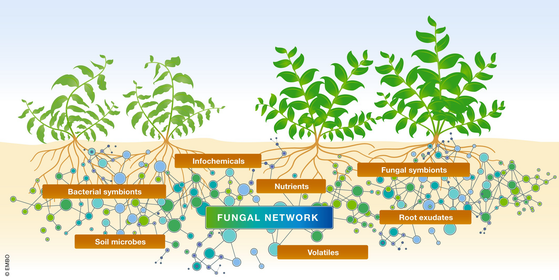
Integrated root and fungal networks. Source: adapted from Baluška and Mancuso (2020).
An important point to highlight is the recognition of the symbiotic network—or interconnected web of life—represented by plants. According to Simard (2021), these systems consist of nodes and links, where some elements act as central nodes or “mother trees.” Plants possess the same complex and emergent properties observed in superorganisms in relation to adaptive behavior. Therefore, the vegetal world demonstrates swarm intelligence, common in self-organizing systems, which allows them to behave as a group and not as individuals. They learn from experience and possess memorization mechanisms. They demonstrate the capacity to solve problems, as well as to survive significant predation (Mancuso & Viola, 2018). The link between urban green networks and climate resilience makes sense from the perspective of plant function and dynamics.
Therefore, the correlation between the brain and the city, understood as complex networks, serves as a pretext for describing and developing an analogous proposal for analyzing and linking urban green networks. Connectivity matrices can be observed at various scales, such as human, urban, and vegetal, where the concept of the connectome transcends from a human connectome to the urban connectome and finally to the urban green connectome, allowing for the development of diverse comparative frameworks across various disciplines and frontiers of knowledge.
The complexity of structures and patterns observed in the brain, and also present in the city, is visualized in spatial typologies—multiscalar and multifunctional—in the combination of gray, green, and blue networks, as well as in the human element, where society participates in spatial connectivity, not only structurally, but also dimensionally and functionally. The city, by including a diversity of natural ecosystems, contains the formula for establishing the contribution of vegetation as synonymous with adaptability, resistance, tranquility, and, of course, climate resilience.
This approach itself visualizes an interweaving of new concepts and elements that help us observe, in diverse ways, the connections, how they are made, what their effects are, what factors and actors are involved, and which, in a way, support the emerging of new disciplines and lines of research derived from neuroscience applied to the study of the city and architecture.
References:
Baluska, F., & Mancuso, S. (2020, febrero 27). Plants, climate and humans. Plant intelligence changes everything. Science & society. doi:10.15252/embr.202050109
Ehecatl, C., & Avid, E. (2023, marzo 9). Vuelo por dron. Fotografías de Zona Coyol. Veracruz.
Haber, S., Liu, H., Seidlitz, J., & Bullmore, E. (2021, Septiembre). Prefrontal connectomics: from anatomy to human imaging. Neuropsychopharmacology(47), 1-21. doi:10.1038/s41386-021-01156-6
Johnson, S. (2001). Sistemas emergentes. O qué tienen en común hormigas, neuronas, ciudades y software. Madrid: Turner. Fondo de Cultura Económica.
Mancuso, S., & Viola, A. (2018). Sensibilidad e inteligencia en el mundo vegetal. Barcelona: Galaxia Gutenberg.
Mehaffy, M. (2019a). Wonders of the “urban connectome”. Retrieved from Future of Places Research Network: https://foprn.org/2019/10/20/wonders-of-the-urban-connectome/
Mehaffy, M. (2019b). Cities are like brains—immense networks of connective tissue. Retrieved from Congress for the New Urbanism: https://www.cnu.org/publicsquare/2019/12/10/wonders-urban-connectome
Simard, S. (2021). Finding the mother tree: Discovering the Wisdom of the Forest. Knopf.
Sporns, O., Tononi , G., & Kötter , R. (2005). The human connectome: A structural description of the human brain. PLoS Comput Biol, 1(4), 245-251. doi:10.1371/journal.pcbi.0010042